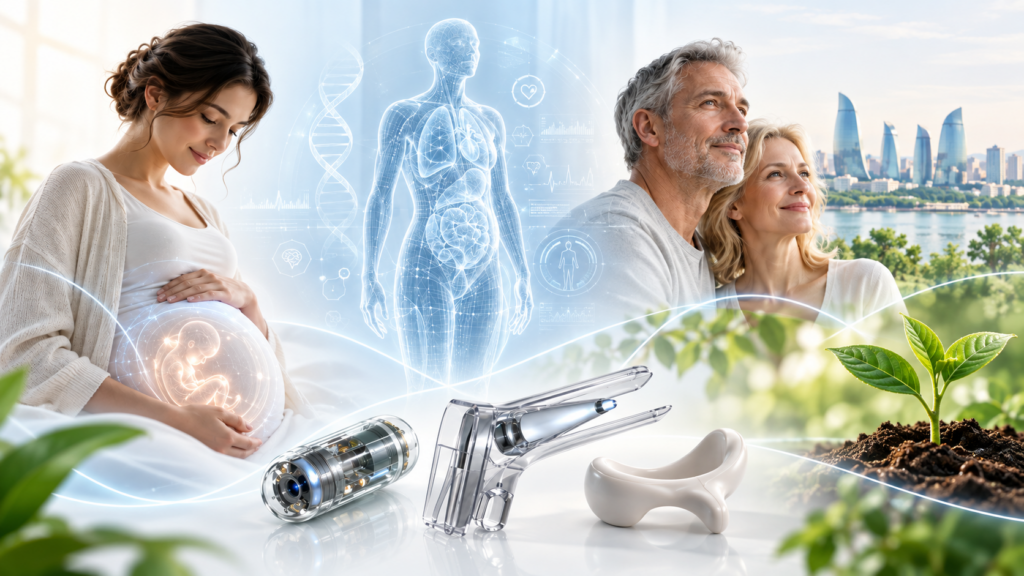
Our ideas emerge from practical medicine – from questions that existing diagnostic and monitoring methods are not yet able to answer fully.
Medicine has access to vast amounts of laboratory, instrumental, and digital data. However, in most cases, these data reflect the state of the human body only at a particular point in time. Between examinations, hours, days, and weeks pass during which physiological processes continue to change.
That is why one of the main directions of our work has become the development of technologies capable of moving from episodic assessment of a person’s condition to long-term dynamic monitoring, and from recording disorders that have already developed to their early prediction.
PHI™ – Intelligent Pregnancy Monitoring
Pregnancy is a dynamic physiological process in which the condition of both mother and fetus changes continuously, while traditional medical monitoring is performed periodically.
This led to the idea of PHI™ – an intelligent predictive pregnancy monitoring system.
The concept involves long-term, non-invasive recording of physiological parameters of the pregnant woman and fetus, followed by analysis of their individual dynamics, variability, and interrelationships.
The goal is not simply to accumulate measurements, but to create a unified dynamic “mother–fetus” profile capable of identifying adverse trends before pronounced clinical manifestations appear.
The integrated result of this analysis is the Pregnancy Health Index – a digital indicator reflecting the condition and dynamics of pregnancy, which may be used for the early identification of risks associated with preeclampsia, preterm birth, gestational diabetes mellitus, anemia during pregnancy, fetal hypoxia, and other complications.
PHI™ does not replace ultrasound examinations, Doppler studies, cardiotocography, or laboratory diagnostics. Its purpose is to create an additional continuous diagnostic layer between scheduled medical examinations.
LIFEMAP HUMAN™ – A Digital Twin for Health and Longevity
If PHI™ focuses on the dynamics of the “mother–fetus” system, the next question was considerably broader: can changes in the human body be monitored in a similar way over the course of many years?
This led to the concept of LIFEMAP HUMAN™ – a personalized digital twin for health and longevity.
The concept is designed to integrate physiological, metabolic, hormonal, immune, genetic, cognitive, psychological, and behavioral data within a single digital model.
Based on these data, biological age, the functional reserves of different body systems, the rate of age-related changes, and an individual aging trajectory can be assessed.
However, the primary purpose of the digital twin is not simply to determine a single number representing “biological age.”
It is far more important to understand:
which system of the body begins to lose its functional reserve first, how rapidly this decline occurs, and whether the predicted trajectory can be changed.
For this reason, we view LIFEMAP HUMAN™ not as a diagnostic test, but as a dynamic model of the individual – one that evolves together with the person and makes it possible to model different scenarios for preserving health and promoting active longevity.
Internal Physiological Resilience Index
The development of this concept led to another question.
Most modern systems assess the human body primarily “from the outside” – through blood tests, medical imaging, functional examinations, and data from wearable devices.
But is it possible to obtain additional information directly from the body’s internal physiological environment?
This led to the idea of an autonomous diagnostic capsule capable of recording a range of intraluminal physiological parameters as it passes through the gastrointestinal tract: temperature, pH, electrical conductivity, oxidation-reduction potential, pressure, motor activity, contraction rhythm, and transit time.
Importantly, each of these parameters has limited diagnostic value when considered individually.
Our idea is different – to analyze them as a unified spatiotemporal dataset.
On this basis, we propose the formation of a multiparametric physiological profile and the calculation of an Internal Physiological Resilience Index – an integrated indicator reflecting the ability of the body’s internal environment to maintain stability and adapt to change.
New Medical Devices
Not all of our ideas are related to digital technologies.
Some of our developments emerged directly from clinical practice, in situations where a conventional medical instrument performs its basic function, but its design limits the physician’s capabilities or reduces patient comfort.
This led to the development of concepts for an advanced gynecological speculum and an adaptive spatial pessary.
The new gynecological speculum is designed to incorporate transparent working elements, integrated illumination, improved visualization of the operating field, ergonomic fixation, and the possibility of targeted delivery of medicinal agents.
The adaptive spatial pessary is being developed as a device designed not only to provide mechanical support for the pelvic organs, but also to take into account the spatial anatomy of the pelvic floor, ensure greater positional stability, and enable localized therapeutic intervention.
What Unites Our Developments
At first glance, pregnancy, longevity, a diagnostic capsule, and gynecological devices belong to entirely different areas of medicine.
Yet all of these projects are based on one common principle:
not simply to detect a disease or disorder once it has already developed, but to identify changes in the body’s physiological balance as early as possible.
We aim to move from individual indicators – to their interrelationships,
from a single examination – to dynamic monitoring,
from diagnosis – to prediction,
from a one-size-fits-all approach – to an individualized model of the human body.
It is this concept that we regard as the foundation for our future scientific and technological developments.